
The State of B2B Digital Marketing - 2026 Edition
Jan 09, 2026
The pace of change in our industry has shifted from rapid to exponential. It is becoming increasingly difficult to keep up with every 'latest development' simply because there is a limit to how much any of us can consume.
At Target Edge, we felt it was time to pause and take a wider view. This report marks our first annual detailed exploration of 'what is going on' in our world. We wanted to sift through the noise and focus on the signals that actually matter. While we have tried to cite the many experts and data sources we learned from, some of the opinions here are grounded in our own experience - admittedly limited, but deeply practical - working with B2B companies throughout this year.
As we head into 2026, B2B marketing for large enterprises is undergoing significant change. From how buyers make decisions to the tools and tactics marketers use, the playbook is being rewritten at a rapid pace.
Below we break down key trends – in buyer behavior, technology, content strategy, budget/team changes, and go-to-market approaches – that are shaping B2B marketing in 2026.
Evolving Buyer Behavior and Decision-Making Patterns
B2B buyers in 2026 are more independent, digitally savvy, and influence-driven than ever. Gone are the days when sales reps guided buyers through a linear funnel – today’s buyers prefer to self-educate and often engage sales late (if at all) in the journey [2].
A few defining shifts in buyer behavior include:
Larger Buying Committees
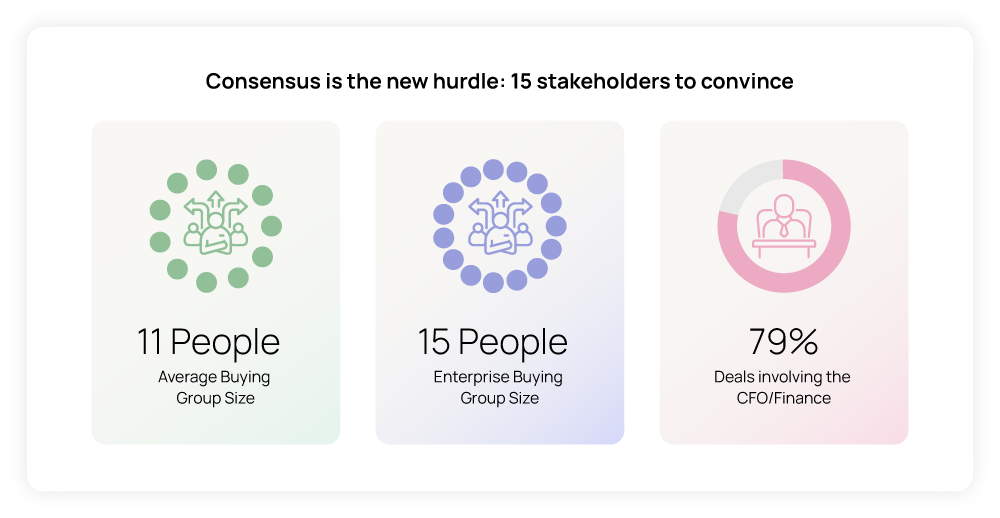
Big B2B purchases now involve extensive stakeholder groups. The average buying group includes around 10–11 stakeholders, and in enterprise deals it’s closer to 15 [3]. Decisions require consensus, often with CXOs like the CFO involved in 79% of purchases [3]. This means marketing must address varied perspectives and build consensus through content and data.
Digital Self-Service & Early Research
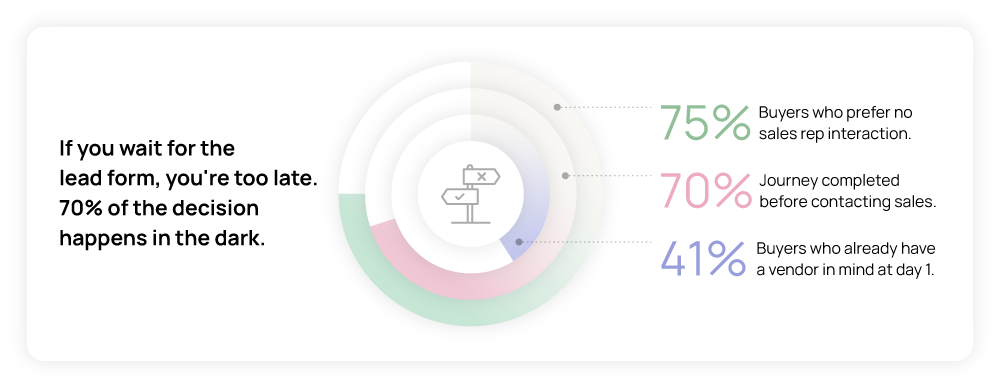
Approximately 75% of B2B buyers would rather not engage a sales rep at all, relying on online research and content to make decisions [2]. In fact, buyers are roughly 70% of the way through their journey (and often have a shortlist of preferred vendors) before ever talking to sales [3]. Millennials and Gen Z now make up over two-thirds of B2B buyers in complex deals, and 73% of all B2B buyer roles – they expect seamless digital experiences and Amazon-like convenience [3].
Pre-Established Preferences
First impressions occur long before buyers raise their hand. According to Forrester, 41% of buyers have a specific vendor in mind from the outset and 92% already have a shortlist when formal shopping begins [4]. This means brands that have nurtured awareness and trust early (“always on” thought leadership, influencer content, SEO) enter the race with a huge advantage. If you’re only engaging buyers at RFP time, you’re too late.
Networked Influence
Decision-makers are heavily influenced by peers and third parties. Buyers “aren’t just reading whitepapers and attending webinars” – they’re scanning Reddit threads, LinkedIn posts, niche newsletters, YouTube reviews, industry forums, and third-party ratings [4]. In fact, half of younger B2B buyers include 10 or more external influencers (analysts, bloggers, practitioner-experts, etc.) in their decision process [4]. Trust in vendor messaging alone is low, so social proof and unbiased expert opinions carry significant weight in decision-making [1][4].
The implication of these shifts is that B2B marketers must cast a wider net to meet buyers on their terms.
The journey is non-linear and “chaotic,” often looping through channels and influencers rather than progressing neatly down a funnel [5]. Brands that win will be those that build early preference, leverage credible voices, and make it easy for self-directed buying teams to get information and consensus without high-pressure sales tactics.
In 2026, marketing’s role is to empower the buyer – providing the right content, at the right time, in the right places – so that when buyers do engage, your solution is already the favored choice [4].
Martech Stack Evolution: AI Copilots, Consolidation, and Compliance
The marketing technology stack of 2026 looks dramatically different than a few years ago. AI has become ubiquitous in B2B marketing tools, and the push for efficiency, integration, and privacy is driving changes in how marketers manage their tech ecosystems.
Key trends in the martech stack include:
AI Everywhere (Rise of the Copilots)
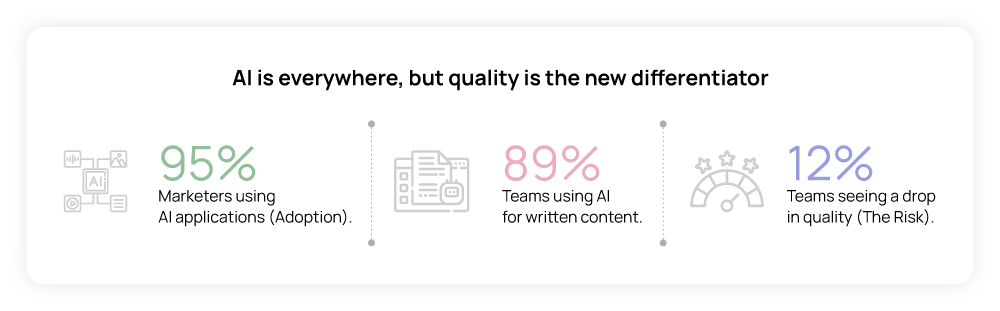
What was experimental is now essential – 95% of B2B marketers report using AI-powered applications in some form [6]. Generative AI and “copilot” features are embedded in content creation, data analysis, sales enablement, and campaign optimization. Nearly 89% of teams use AI for generating or refining written content [6], and over half use AI for imagery and creative work [6].
The payoff has been speed and productivity – 87% report higher content output and 80% see improved efficiency from AI assistance [6]. However, AI is not a panacea; while it helps marketers “type faster,” it doesn’t always help them think better [6]. In fact, 12% of marketers found content quality dropped with AI use [6]. This is leading to more nuanced use of AI: leveraging it for drafts, data crunching, and repetitive tasks, while reserving human insight for creativity, strategy, and quality control [6].
Governance and Risk Management
The rapid infusion of AI carries risks if left unchecked. Forrester warns that ungoverned generative AI in commercial apps will cost B2B companies over $10 billion in losses by 2026 due to errors, legal issues, and brand damage [1]. Cases have already emerged of firms having to refund clients because AI-created deliverables contained hallucinations or “slop” [1].
As a result, organizations are prioritizing AI governance – setting up guardrails, review processes, and employee training to raise the “AI IQ” across their teams [1]. Marketing leaders must ensure AI-driven content and decisions are vetted for accuracy, bias, and brand compliance before they reach customers.
The motto: “trust, but verify” every AI output.
Stack Consolidation around Data
After years of adding more tools, many enterprises are streamlining their martech stacks. Rather than a jumble of siloed platforms, stacks are “consolidating around unified data foundations” [7]. This means investing in central customer data platforms (CDPs), data warehouses, and integration layers that connect marketing, sales, and customer systems.
By unifying data and tools, marketers reduce fragmentation, improve consistency, and simplify vendor management [7]. The goal is to have a single source of truth on customers and campaigns, which not only boosts efficiency but is also crucial for effective AI (clean, connected data yields better AI insights [7]).
In 2026, savvy teams are less impressed by having 50 apps in their stack; they’re more concerned with how well those tools talk to each other and to their strategy [5]. “Composable” architectures – swapping in modular tools built around your strategy (not vice versa) – are becoming popular, giving marketers flexibility without tool bloat [5].
Privacy-First and Compliance by Design
With data privacy regulations tightening worldwide (GDPR, CPRA and others) and the deprecation of third-party cookies looming, 2026 is truly the year of first-party data. Some 91% of B2B marketers are now actively collecting first-party data from their audiences [6]. However, many are still catching up on strategy – about half say their first-party data strategy is in exploratory or developing stages [6].
A critical focus is data governance: only 52% of marketers consider their data governance “established or advanced,” leaving nearly half with shaky controls over data quality, access, and compliance [6]. Poor governance isn’t just an IT issue – it’s a marketing liability, as inconsistent or non-compliant data use can lead to mistakes and breaches [6].
In 2026, leading marketers treat privacy and consent as default – moving to cookie-less tracking methods, obtaining clear opt-ins, and building robust value exchanges (useful content, tools, or experiences in return for customer information) [8]. The payoff is twofold: mitigating legal risks and building trust. Brands that handle data transparently and responsibly will earn customer confidence, whereas those who don’t will “spill more than they store” when it comes to data advantage [6].
In summary, the martech evolution is about smarter tech, not just more tech. Teams are embracing AI and automation to operate at scale, but they’re also simplifying their stacks and tightening data practices to stay agile and compliant.
The mantra for 2026: move fast, but keep it clean and under control.
Marketing organizations that balance innovation with governance – using AI as an accelerator with human oversight, unifying their data, and respecting customer privacy – will outcompete those that either lag behind or charge ahead blindly [1][7].
Content, Messaging, and Trust-Building Trends
In a world overflowing with content – much of it now machine-generated – B2B marketers are rethinking their messaging strategies to earn genuine trust and attention. Content quality, authenticity, and authority have become the north stars of 2026’s marketing playbook.
Several notable trends are emerging in how brands craft content and build credibility:
Thought Leadership & Human Expertise Matter More
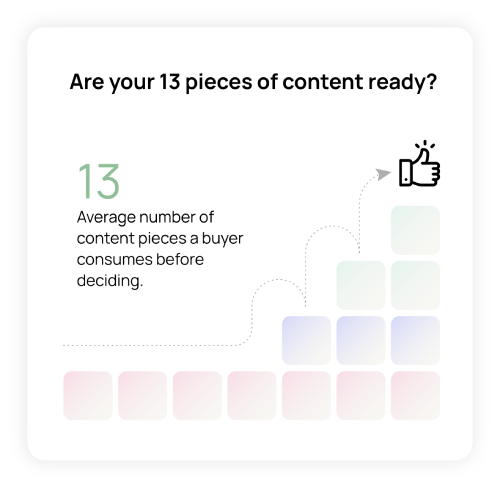
B2B buyers are hungry for insightful, credible content that helps them make decisions. Almost 90% of B2B buyers say online content has a moderate or major impact on purchasing decisions, consuming an average of 13 pieces of content along their journey [3]. But crucially, not all content is equal – buyers favor expertise.
This is driving a boom in thought leadership and influencer marketing in B2B. In fact, 75% of enterprise B2B firms plan to increase budgets for influencer engagement in 2026 [1]. These “influencers” aren’t flashy Instagram stars, but subject-matter experts, industry analysts, and credible creators who have the ear of your target audience. Buyers increasingly rely on respected outside voices for insights, so brands are partnering with analysts, tech community leaders, niche bloggers, and even their own satisfied customers to co-create content that carries trust [1].
Additionally, companies are investing in their executives’ and employees’ voices – enabling internal experts to publish articles, speak on webinars, and build personal brands (often termed employee advocacy or “internal influencers”) to humanize the company. Nearly every B2B organization (96%) produces thought leadership content now [6], but the challenge in 2026 is scaling it authentically. Many programs are still immature – over two-thirds of companies report only minimal to limited participation from their knowledgeable employees in content creation [6]. The leaders will be those who turn more of their people into trusted voices (with training and incentives), rather than relying on a few marketers or execs to do all the talking.
From Information to Insight: Answer Engine Optimization (AEO)
With AI-driven search and chatbots (the so-called “answer engines”) becoming a common way buyers find information, content must do more than provide basic info – it must guide decisions. Forrester highlights that most B2B content today is designed to explain, but fails to frame comparisons, trade-offs, and concrete advice, leaving a gap that AI or third-party sources will fill [1].
In 2026, smart marketers are focusing on Answer Engine Optimization (AEO) – structuring content to directly answer specific buyer questions and help them evaluate options. This means creating rich FAQ pages, comparison guides, decision trees, and interactive tools that an AI assistant or search engine can easily pull as a definitive answer [8].
The content strategy is shifting from just generating more posts to delivering depth and utility: if a prospect asks an AI, “What’s the best solution for X?” – will the AI draw on your content as the trusted source? Brands are aiming to ensure the answer is “yes” by publishing high-value, unbiased content that showcases expertise and addresses buyer dilemmas (not just product pitches).
In short, content must evolve from mere thought leadership articles to decision-support assets.
Those who embrace AEO and truly help buyers make choices will gain a significant edge in discovery and trust.
Quality Over Quantity (Combating Content “Weirdness”)
The ease of generating content with AI means the internet is being flooded with mediocrity. B2B audiences, in turn, are becoming more skeptical of cookie-cutter blogs and generic spam. The trend for 2026 is a flight to quality in content and messaging. Marketers are cutting back on low-value content and doubling down on pieces that demonstrate original insight, data, or strong a point-of-view.
There’s also an emphasis on consistency and brand voice – ensuring that with many team members (and machines) creating content, it all adheres to a coherent narrative and standard. Leaders are implementing stricter content governance and editorial oversight, knowing that unchecked AI content can “get weird” or off-brand if it’s not carefully reviewed [6]. By training employees on content guidelines and providing approval workflows, companies protect their credibility.
As Forrester puts it, without frameworks and guardrails for the new influx of AI-driven content creators, brands risk diluting their message and degrading customer experience [1]. In 2026, fewer, better pieces of content – ones that audiences actually trust and find valuable – will outperform a high volume of forgettable posts.
Multi-Format, Experiential Content to Build Trust
B2B content is not just whitepapers and blogs anymore. Marketers are embracing rich media and experiential tactics to engage jaded audiences.
- Video: Short-form video has surged in popularity – 70% of B2B buyers watch videos as part of their research, and many prefer video over text to learn about solutions [3]. Marketers report video delivers among the best ROI of any format [3]. Thus, 2026 will see more product demo videos, expert interview series, animated explainers, and even TikTok/YouTube-style content aimed at professional audiences.
- In-Person Events: At the same time, after years of purely digital interaction, in-person and live experiences are making a comeback as trust-building plays. About 78% of B2B marketers are investing in experiential marketing (events, workshops, executive roundtables, etc.) [6] – acknowledging that face-to-face engagement, or high-touch virtual events, can forge deeper relationships than yet another email campaign. These experiences don’t have to be giant trade shows (indeed, some analysts caution that large-scale events may carry more risk than reward in 2026); many companies are opting for smaller, targeted gatherings or hybrid events that offer meaningful interaction.
The underlying theme is humanization: whether via video or in-person, putting real faces and personalities forward. Buyers are more likely to trust a brand that shows up with authenticity – be it a candid video series, a responsive webinar Q&A, or a helpful community forum – than one that hides behind polished PDF brochures. In an AI-influenced era, the human touch becomes a key differentiator. Brands are striving to “show up” wherever it counts – both online and offline – to earn buyer confidence through transparency, responsiveness, and shared experiences [6].
In essence, trust is the currency of B2B marketing in 2026. Buyers must trust that your content is truthful and genuinely helpful (not just marketing fluff), trust that your experts are knowledgeable, and trust that your brand understands their needs. Successful marketers are using a mix of high-authority content (backed by data or expert opinions), strategic thought leadership, and engaging formats to build that trust over time.
The result of these efforts is not immediate conversion, but “compound credibility” – an accumulated reputation that, when the buyer is finally ready to choose, heavily favors the trusted brand [6]. In a time when AI can generate an article in seconds, real credibility has become the holy grail of marketing – hard to earn, easy to lose, and utterly invaluable for the long haul.
Budget Allocation, Team Structures, and Operational Shifts
After a few volatile years, B2B marketing budgets are rebounding in 2026 – and marketing teams are reorganizing for agility and impact. A majority of B2B marketers expect their budgets to increase this year, but there is also intense pressure to spend wisely and show results [9].
Here’s how budgets and teams are evolving:
Renewed Investment in Brand and Content
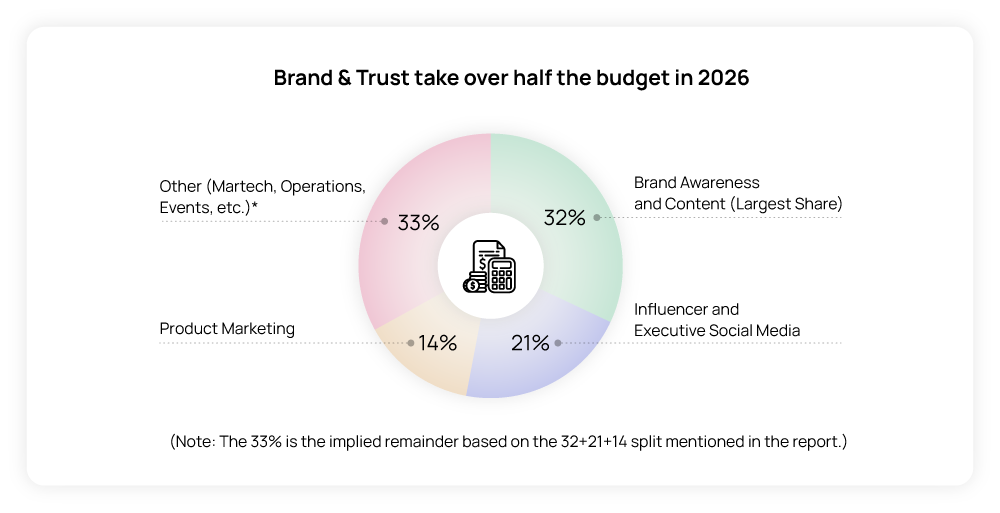
In 2026, brand awareness and content marketing are top budget priorities, reflecting a strategic shift from short-term lead generation to long-term growth [9]. One survey of 400 senior marketers found that brand awareness and content together account for the largest share of spend (about 32% combined), higher than even lead gen or product marketing [9]. Nearly 70% of marketers plan to boost spend this year, and very few intend to cut back on brand-building programs [9].
The logic: in an “AI-filtered” world where buyers rely on reputation and trust (and where ads may be ignored or filtered out), investing in brand credibility and consistent content is seen as key to winning attention [9]. This translates into budget line items like executive thought leadership, social media presence, influencer partnerships, and PR – in fact, spend on corporate/executive social media and influencer marketing is set to grow, comprising about 21% of marketing investments in one study [9].
Performance marketing isn’t dead, but companies are allocating more dollars to make sure their brand is the one buyers already know and prefer (as discussed in “preference marketing”). Notably, product marketing is also getting about 13-14% of budgets [9] as companies work to clearly articulate value and differentiation in crowded markets.
Operating Leaner and Smarter
Even with budget growth, CMOs are expected to do more with less in terms of team resources. Many are cautious about adding lots of headcount; instead, they’re optimizing team structure and processes. Interestingly, while skill development and new roles are critical, marketers ranked training and team development among the lower budget priorities for 2026 [6] – indicating that extra dollars are going more into programs and tech than hiring.
Some companies are addressing skill gaps via outsourcing or fractional roles (e.g. fractional CMOs, specialized agencies) to stay flexible [2]. On the flip side, leading enterprises are making sure they retain and empower their top talent – since content quality, creativity, and strategic thinking depend on people, not just tools [6].
We also see marketing teams becoming more cross-functional: for instance, forming “pods” that include marketers, sales development reps, and sometimes product/customer success liaisons to jointly tackle target accounts (blurring the line between marketing and sales activities). The concept of Revenue Operations (RevOps) continues to grow, aligning marketing ops, sales ops, and analytics under one umbrella to streamline the funnel.
In fact, 89% of marketing leaders say their current budgets and plans are well-aligned with their company’s revenue goals, and the C-suite is more bought-in to marketing strategy than in years past [9]. This indicates a healthier marketing-sales-exec alignment, often facilitated by shared metrics and planning.
Agile, Always-On Execution
The pace of change (technological and in buyer behavior) means marketing teams are adopting more agile workflows. Rather than annual plans set in stone, 2026 teams are running continuous campaigns with frequent checkpoints. For example, some B2B orgs hold weekly “stand-ups” to review data on engaged accounts, pipeline gaps, and campaign results, and then quickly adjust tactics or reallocate budget on the fly [8].
This agile approach is complemented by new KPIs focused on responsiveness – e.g., measuring how fast marketing reacts to buyer signals or hands off leads, not just the volume of leads. Teams are also measuring deeper funnel impact: beyond MQLs to metrics like pipeline velocity, win rates, and customer lifetime value influenced by marketing [8].
The operational ethos is test, learn, and iterate. Marketers are encouraged to pilot new ideas (say, a new AI tool, a niche community sponsorship, or an ABM tactic) on a small scale, quickly keep what works and drop what doesn’t, then scale up successes [8]. In terms of collaboration, sales and marketing alignment has tightened – many teams enforce SLAs such as contacting any high-intent lead within 24 hours, with marketing providing rich context (behavior data, content consumed) to sales for a warmer follow-up [8]. Organizational silos are breaking down gradually in service of a smoother end-to-end revenue engine.
New Roles and Team Capabilities
As B2B marketing expands in scope (with content, data, technology, and customer experience all in play), new roles are appearing on teams. Companies are appointing “AI specialists” or AI ethicists to help govern AI usage, data analysts to mine insights from the marketing data lake, and customer marketing managers to focus on retention and expansion of existing clients.
In some firms, marketers are even taking on quasi-product roles – for instance, using no-code and AI tools to prototype customer-facing apps or interactive content.
A bold prediction from industry watchers: marketers will increasingly act as product managers.
With AI “copilots” lowering the technical barrier, marketing professionals can ideate and test product or service enhancements (especially digital experiences) without heavy developer reliance [10]. This empowers marketing to ensure the product itself delivers on customer needs and marketing promises. We’re already seeing hybrid job titles emerge, like “Growth Marketing Manager – Product Experience” or “Marketing Engineer”, reflecting the convergence of marketing, product, and IT skill sets [10].
Similarly, content teams are evolving; Forrester predicts that by the end of 2026, two-thirds of B2B content will be created by employees outside the traditional marketing content team (enabled by tools like generative AI) [1]. This means the role of the central content team shifts to being curators, coaches, and quality guardians, rather than writing every asset. Marketing leadership must cultivate a culture where everyone – from sales reps to product engineers – can contribute ideas or content, while maintaining a strong brand voice and accuracy through oversight [1].
The net result is a more decentralized but versatile team, with marketing at the hub orchestrating contributions from across the organization.
In summary, B2B marketing organizations in 2026 are investing for growth but also retooling how they work. Budgets are flowing into activities that build a resilient brand and engage buyers throughout the life cycle, not just the top of the funnel [9]. Teams are becoming more agile and aligned, often working hand-in-hand with sales and product peers to drive revenue. And while headcounts may not explode, the capabilities and roles within marketing are certainly expanding. The modern B2B marketing team looks more like a multi-disciplinary “revenue team”, one that is data-driven, experiment-friendly, and tightly linked to business outcomes.
Crucially, CMOs have earned greater trust from CEOs/CFOs by demonstrating how marketing efforts translate to pipeline and growth – which bodes well for continued or increased budget support going forward [9]. The challenge now is to execute with discipline: as one marketing CEO noted, “we have more budget, and more pressure to allocate it where it matters” [9]. The winners will be those who can balance creativity with accountability, building brand equity while also contributing directly to revenue.
Go-to-Market Strategy Shifts in 2026
Perhaps the most profound changes are happening in go-to-market (GTM) strategies. B2B companies are fundamentally rethinking how they approach the market – from initial brand discovery to sales conversion and customer expansion.
In 2026, several GTM themes stand out:
“Full-Funnel” Account-Based Marketing
ABM has matured from a niche tactic to a core strategy. Roughly 67% of brands are using account-based marketing, and over 90% of SaaS marketers rate ABM as very successful for them [11]. In 2026, ABM is no longer just for new logo acquisition – it’s expanding across the entire customer lifecycle [11].
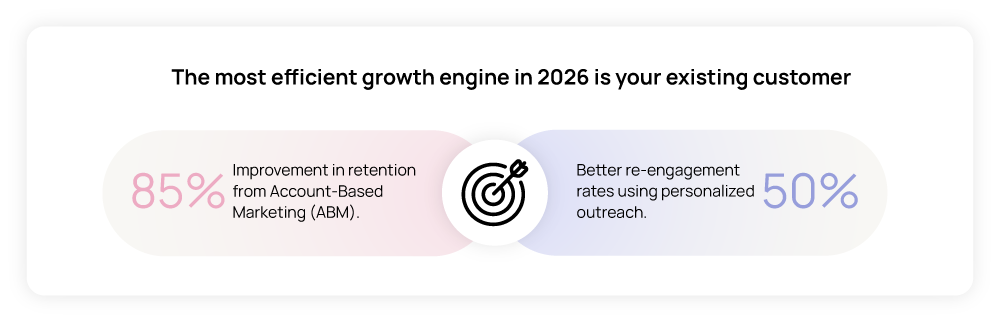
Leading companies treat their top accounts to ongoing one-to-one marketing, focusing not only on closing the deal but on retention, upsell, and advocacy (sometimes called account-based experience or “ABX”). For example, personalized campaigns don’t stop once a client is signed; marketers continue to target customers with education, success stories, and even renewal prompts tailored to their usage. This is paying off: an AdRoll study noted 85% of marketers saw improved customer retention through ABM efforts [11].
Tactically, this means GTM teams set metrics for post-sale engagement (health scores, product adoption rates) and coordinate closely with customer success teams. It also means high-touch experiences for key clients – from customized webinars for a single account to sending executives to meet a customer’s team. The mantra is to treat important customers as markets of one. By extending ABM to retention and cross-sell, companies aim to drive revenue growth more efficiently (expanding existing relationships) and increase loyalty in an era where switching is easy.
Customer Experience & Loyalty as Growth Drivers
Related to the above, customer marketing and loyalty programs are taking center stage in GTM plans. With acquisition costs rising and buyers cautious, B2B firms realize that nurturing their existing customer base can yield the best ROI. In 2026, more marketing departments have dedicated customer marketing roles and budgets to run programs like user communities, customer advisory boards, loyalty incentives, and referral campaigns.
The mindset is shifting from “marketing brings leads, sales closes them” to “marketing owns the customer relationship alongside sales” throughout the journey [11]. Expect to see more hybrid engagement: for instance, a company might host an exclusive customer summit (in-person experience) combined with a personalized digital content portal for customers – blending offline and online touchpoints to strengthen the partnership [11].
Satisfied customers can become brand advocates, which is invaluable when peer recommendations heavily influence new buyers. Thus, GTM strategy now explicitly includes turning customers into a marketing asset. Some stats illustrate this emphasis: companies using highly personalized outreach to current customers have significantly better re-engagement rates (e.g. 50% better in one study) [11]. Ultimately, loyalty is viewed as the core of revenue growth, not an afterthought – a big change from the days when marketing handed off at the sale.
Early-Stage Positioning and “Preference Marketing”
As discussed earlier, buyers are forming opinions well before they ever engage vendors. This has given rise to what’s being called “preference marketing” – strategies aimed at shaping buyer perception before any direct intent signals appear [4].
In practice, this means GTM teams are investing more in brand content, PR, and thought leadership to ensure that when a prospect starts researching, their company is already on the radar or viewed favorably. For example, organizations are sponsoring independent research reports, appearing on industry podcasts, and contributing useful insights in communities without a sales pitch. The idea is to be the brand buyers think of first in your category, shortening the trust-building process later.
It ties back to the stat that 41% of buyers have a vendor in mind at journey start [4] – GTM strategy now fights to be in that initial consideration set. Importantly, this is not just generic “awareness” marketing; it’s targeted and educational, often focusing on key problem areas or trends that resonate with the audience. Leading marketers are reallocating spend from pure lead-gen ads into these upper-funnel efforts (content partnerships, high-profile speaking gigs, engaging creators/experts to amplify their message) [4].
The measure of success is not just clicks, but whether your brand is preferred when the buyer finally has budget and intent. This approach acknowledges that in 2026, if you wait for the RFP to start marketing, you’ve already lost.
Multi-Channel, Buyer-Centric Engagement
The complexity of the modern buying journey – with its many channels and influencers – means GTM strategies must be truly omnichannel and buyer-centric. It’s not enough to run LinkedIn ads and host a webinar and call it a day. Marketers are mapping out a “Buyer Influence Map” that charts all the touchpoints and information sources a typical buyer interacts with [4].
This often includes non-traditional channels: e.g. popular industry Slack groups, Reddit forums, third-party review sites (like G2, Capterra), YouTube channels run by enthusiasts, newsletters by independent experts, etc. In 2026, successful GTM plans meet buyers where they already are – which means extending presence into these arenas in an authentic way [4].
Concretely, companies are doing things like partnering with niche community owners to sponsor content or provide experts for an AMA (Ask Me Anything) session, ensuring their product has plenty of positive reviews on independent platforms, and engaging on social media not just via brand accounts but through employees and advocates. The channel mix has broadened: a “campaign” might involve a mix of search engine optimization (including answer engines), content syndication to targeted sites, participation in virtual communities, and programmatic ads – all coordinated to influence the buyer collectively.
The tone also has to fit the channel; for instance, a technical audience might prefer a no-nonsense whitepaper and a discussion in a Stack Exchange forum, whereas a business audience might engage with an interactive ROI calculator and a LinkedIn Live event. The principle is being context-aware: as one guide put it, stop asking “What do Millennials (or any segment) want?” and start asking “What does this person need right now, given what they just did?” [5]. Marketers, aided by better analytics and intent data, are getting better at delivering the right message on the right channel at the right moment. Those who excel at this will cut through the noise and provide a seamless journey, while those who stick to a rigid funnel model will miss influencing many key moments [5].
Data-Driven Precision and AI in GTM
Finally, 2026 GTM strategy is highly data-driven and increasingly augmented by AI. Marketing and sales teams are using predictive analytics and AI agents to optimize how they target and engage prospects. For example, AI models can score accounts for propensity to buy by analyzing thousands of signals (website visits, intent data, engagement with content, firmographic data) – enabling what some call “autonomous lead qualification”. According to industry reports, 91% of marketers plan to use intent data for account prioritization and personalized content in 2026 [11].
Additionally, companies are embedding AI agents in lead workflows: an AI might automatically send a personalized introductory email to a new lead, or adjust a nurture track in real-time based on the lead’s behavior, or alert a rep when an account shows surge activity [4]. These AI-driven touches supplement human effort, aiming to catch opportunities that humans might miss or take too long to react to. Key benefits cited include faster time-to-engage (reducing lag from signal to response) and more precise targeting that focuses sales effort on truly hot accounts [4].
Of course, this comes with the need for data hygiene and oversight – teams must ensure the data feeding AI is clean and that automated outreach doesn’t go off-script or violate compliance guidelines [4]. When done right, AI in GTM acts like a scalable “assistant” that helps nurture leads and even guide prospects through initial stages (via chatbots or interactive recommendation engines), freeing up human sellers to focus on high-value interactions.
The endgame is a GTM motion that is highly responsive, personalized at scale, and efficient, using AI to augment human creativity and relationship-building. We also see more experimentation with product-led growth (PLG) strategies: letting the product sell itself via free trials or freemium models and using usage data to identify when to upsell. Many SaaS enterprises now blend PLG with traditional sales – marketing monitors product sign-ups and usage patterns (often with AI analysis) to inform sales of the best moments to intervene or the best users to target, essentially treating the product usage as another marketing channel.
All these changes represent a move toward a holistic, integrated go-to-market strategy. Silos between marketing, sales, and product are dissolving because the buyer doesn’t distinguish between them – they see one continuum of experience. Forward-thinking companies are aligning all customer-facing functions around a unified GTM strategy that is buyer-obsessed and adaptive.
Marketing in 2026 is as much about retention and expansion as acquisition; it’s as much about being found in the right places as it is about proactively reaching out. The playbook now mixes brand narrative and data science, human touch and automation, broad reach and one-to-one precision. It’s a challenging balancing act, but those who master it are poised to thrive.
As one report put it, marketing success in 2026 will hinge on visibility, credibility, and governance – being visible in the new discovery channels, building credibility through human-centric content, and maintaining discipline through data and AI governance [12]. The companies that adapt their go-to-market strategies now, embracing these trends, will lead their industries and win the trust – and business – of the next generation of B2B buyers.
References:
-
[1] Forrester. (2025). Predictions 2026: B2B Marketing, Sales, And Product Leaders - Trust Gets Tested.
https://www.forrester.com/blogs/predictions-2026-trust-gets-tested-for-b2b-marketing-sales-and-product-leaders/ -
[2] Demand Gen Report. (2025, February). “Adapting Your B2B Buyer Journey in 2025”.
https://www.demandgenreport.com/uncategorized/scale-smarter-not-harder-adapting-your-b2b-buyer-journey-in-2025/48793/ -
[3] Thunderbit. (2025). “B2B Buying Stats 2025 Edition”.
https://thunderbit.com/blog/b2b-buying-stats -
[4] TechnologyAdvice. (2025, October). “3 Trends Redefining B2B Marketing in 2026”.
https://solutions.technologyadvice.com/blog/3-trends-that-will-redefine-b2b-marketing-and-demand-generation-in-2026/ -
[5] Destination CRM. (2025, December). “Three MarTech Shifts That Matter for 2026”.
https://www.destinationcrm.com/Articles/Web-Exclusives/Viewpoints/Beyond-the-AI-Noise-Three-MarTech-Shifts-That-Matter-for-2026-172867.aspx -
[6] Content Marketing Institute. (2025). B2B Content Marketing Insights for 2026.
https://contentmarketinginstitute.com/b2b-research/b2b-content-marketing-trends-research -
[7] Improvado. (2025). “Top 10 MarTech Trends to Watch in 2026”.
https://improvado.io/blog/marketing-technology-trends-and-innovations -
[8] DemandWorks. (2025). “Emerging B2B Marketing Trends for 2026”.
https://www.dwmedia.com/blog/emerging-b2b-marketing-trends-for-2026/ -
[9] Demand Gen Report. (2026, January). “Majority of B2B Marketers Plan to Increase Spend in 2026”.
https://www.demandgenreport.com/industry-news/news-brief/10fold-majority-of-b2b-marketers-plan-to-increase-spend-in-2026/51310/ -
[10] Marketer Milk. (2025, November). “7 Top Marketing Trends for 2026”.
https://www.marketermilk.com/blog/marketing-trends-2026 -
[11] AdRoll. (2025). “9 B2B Marketing Predictions for 2026”.
https://www.adroll.com/blog/9-b2b-marketing-predictions-2026 -
[12] eMarketer. (2025, November). “B2B Marketing Trends to Watch in 2026 – Visibility, Credibility, and Governance”.
https://www.emarketer.com/content/b2b-marketing-trends-watch-2026